
Choose a topic below. Tap to open the advice you need.
Before you start
Estate agency interviews are rarely just about whether you can answer a list of questions. Employers are trying to establish whether you can communicate confidently, build trust, generate business, handle pressure, negotiate and ultimately contribute commercially to a branch.
A good interview therefore needs more than rehearsed answers. You need examples that demonstrate how you think, how you work with customers and how you produce results.
Common estate agency interview questions — and how to approach them
1. Why do you want to work in estate agency?
The weak answer is simply that you like property. A stronger answer connects property with the actual work: customers, sales, negotiation, targets, pace and building relationships.
2. Why do you want to work for our agency?
This question quickly exposes poor preparation. Research the agency's local presence, market, brand positioning, branches, people and the types of property it handles. Your answer should explain why that environment fits you rather than simply praising the company.
3. Tell me about yourself.
Do not give your entire life story. Build a 60–90 second career summary: where you are now, the most relevant experience or achievements, what you are good at and why this move makes sense.
4. What makes a successful estate agent?
Strong answers normally go beyond being personable. Think about prospecting, follow-up, resilience, organisation, negotiation, local knowledge, customer communication and commercial awareness.
5. Tell me about a difficult customer or negotiation.
Use a clear situation → action → result structure. Explain the problem briefly, spend most of the answer on what you did and finish with the outcome and what you learned.
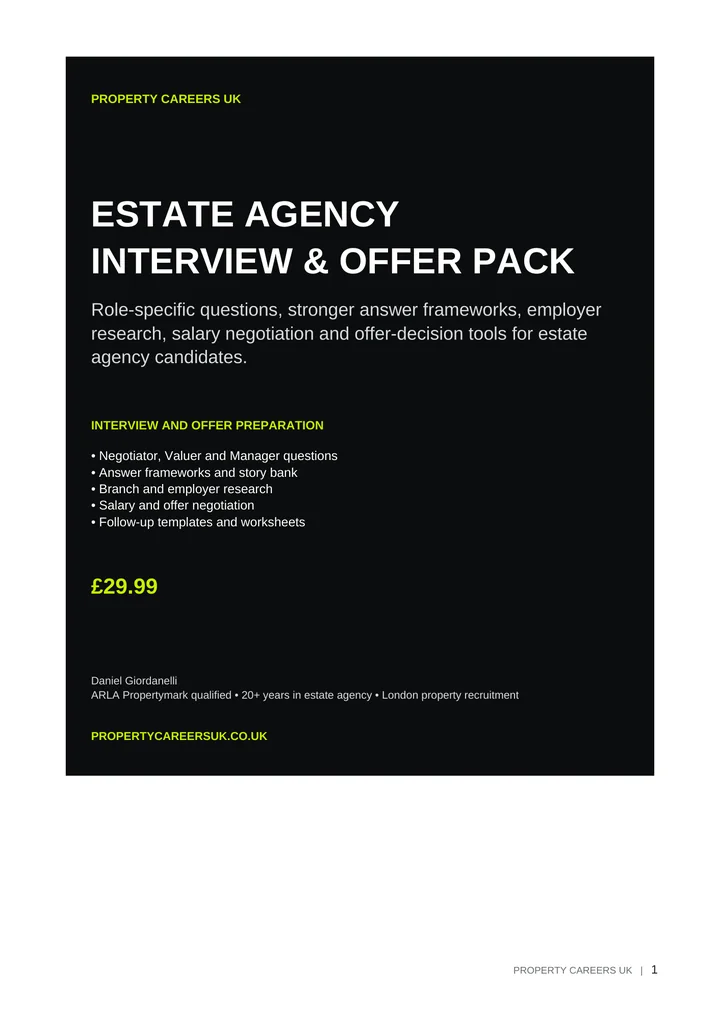
Get the complete Estate Agency Interview & Offer Pack
Use the full preparation pack for estate agency-specific questions, answer frameworks, preparation checklists, recruiter insight and salary-negotiation guidance.
View the Interview & Offer Pack →Sales & lettings negotiator interview questions
Negotiator interviews tend to focus heavily on activity, resilience, customer handling and your ability to convert opportunities.
- How would you generate new business in a quiet market?
- How do you build rapport with applicants?
- How would you handle an applicant who repeatedly makes low offers?
- How do you prioritise calls, viewings, follow-up and administration?
- Tell me about a target you achieved or exceeded.
- How would you turn a valuation opportunity into an instruction for the branch?
- What would you do if a vendor or landlord was unhappy with activity?
Valuer / lister interview questions
At valuer level, employers are assessing whether you can win instructions rather than simply service existing business.
- Talk me through how you prepare for a market appraisal.
- How do you justify your valuation to a vendor or landlord?
- How do you deal with an overvaluing competitor?
- What is your instruction-to-market conversion rate?
- How do you protect fee?
- How do you generate valuation opportunities?
- Give an example of an instruction you won against strong competition.
If you are already working as a valuer, know your numbers. Vague claims such as “I do quite well” are much less persuasive than being able to discuss instructions, conversion, fees, pipeline and performance accurately.
Branch Manager / Director interview questions
Management interviews move from personal production towards leadership and branch economics.
- How would you improve an underperforming branch?
- Which KPIs would you monitor and why?
- How do you manage an underperforming negotiator?
- How would you increase market share?
- How do you balance personal billing with leadership?
- How do you recruit, retain and develop strong people?
- Tell me about a commercial decision you made that improved performance.
At this level, prepare evidence. Be ready to discuss team size, revenue, instructions, exchanges/deals, conversion, fees, market share or other relevant measures from your role.
How to prepare for an estate agency interview
Research the branch, not just the brand
Understand the local patch. Look at the agency's current listings, price points, competitors and how it presents itself. If you are interviewing for a London role, demonstrate that you understand the specific market rather than talking about “London property” as one market.
Know your numbers
Experienced candidates should prepare accurate examples of targets and results. New entrants should identify measurable achievements from previous roles.
Prepare examples, not scripts
Memorised answers can sound artificial. Instead, prepare a bank of genuine examples covering sales, customer service, resilience, negotiation, targets, teamwork, difficult conversations and problem solving.
Know why you are moving
Be able to explain what you want next without turning the interview into a complaint about your current employer.
Common estate agency interview mistakes
- Doing almost no research on the company or branch.
- Saying you want estate agency simply because you “love property”.
- Giving long answers without a clear result.
- Not knowing your own performance figures.
- Speaking negatively about a previous employer.
- Focusing entirely on what the employer can give you rather than the value you can bring.
- Having no useful questions prepared for the end of the interview.
Good questions to ask at an estate agency interview
- What would success in the first six months look like?
- What are the branch's biggest opportunities at the moment?
- How is performance measured?
- What does the commission or bonus structure reward?
- What separates your strongest performers from the rest?
- What progression could realistically follow this role?
What should you wear to an estate agency interview?
Estate agency remains a client-facing profession, so err towards polished and professional. The exact dress culture differs by brand and market, but appearing more professional than necessary is generally safer than looking underprepared. If you know the agency has a particular style, use that as context without trying to imitate it unnaturally.
How should you discuss salary and OTE?
Understand the full package: basic salary, individual commission, team commission, thresholds, accelerators, bonuses and any car allowance or benefits. OTE only becomes meaningful when you understand how it is achieved. If asked about expectations, give a commercially sensible range based on the role and your track record rather than choosing a number with no explanation.
Prepare for the role with recruiter-led support
The £75 Career Strategy & Job Search Support service begins with a focused 45-minute call with Daniel. The preparation is shaped around your actual role and experience, including likely questions, answer structure, common mistakes, salary negotiation and brand-specific insight where relevant.
After the call, you receive the relevant interview questions, answer frameworks, checklists and salary resources discussed, so you can continue preparing from a clear plan rather than trying to remember everything from the conversation.
Book Career Strategy Support — £75 → Or view the Interview & Offer Pack →Final interview checklist
- Research the company, branch and local market.
- Know your CV and performance figures.
- Prepare 6–8 strong examples from your experience.
- Know why you want this role and this employer.
- Prepare intelligent questions to ask.
- Understand the likely salary and commission structure.
- Plan your journey or video setup in advance.
- Follow up professionally after the interview.
Related guides: How to get into estate agency with no experience · Estate agency CV guide · Estate agent salaries in London.